
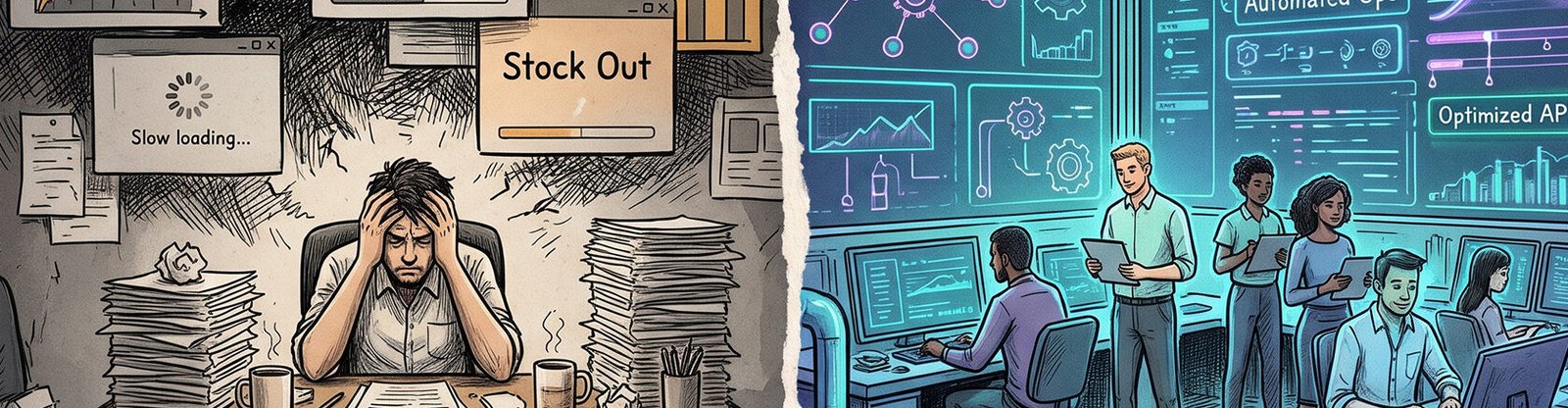
Most founders and operations managers I know start their week the exact same way: staring at six different browser tabs.
One tab for Google Analytics. One for Stripe. Another for HubSpot, one for the warehouse ERP, and a messy Google Sheet someone exported on Friday evening.
You spend hours squinting at charts, only to discover things you can’t change anymore:
- “Oh, conversion dropped 15% last Thursday.”
- “Looks like our top-selling item ran out of stock two days ago.”
- “We had 50 users abandon checkout right at the shipping step.”
That isn’t intelligence. That’s just reading an autopsy of last week’s business.
Knowing what went wrong after the damage is done is frustrating. The real breakthrough happens when your web application stops acting like a digital spreadsheet and starts acting like an active team member that solves problems in real time.
The Problem With Modern “Analytics”
Almost every growing company buys five different SaaS tools hoping for clarity. What they actually get is data chaos:
- Your data doesn’t talk to each other: Your user behavior sits in Mixpanel, your money is in Stripe, and your actual inventory is locked in an on-premise database. Good luck getting them to agree on the same number.
- You’re paying a massive speed penalty: When you paste five different tracking scripts into your website’s header, your pages slow to a crawl on mobile. You’re literally hurting your Google rankings just to collect charts nobody looks at.
- Data trapped in Python notebooks: Your data analyst might build a brilliant prediction model, but if it lives in a local Jupyter notebook instead of your live website, it’s completely useless to your everyday customers.
What a “Decision Engine” Actually Looks Like in the Real World
When you build data science directly into your web architecture, you don’t wait for someone to pull a CSV report. The app acts automatically:
- Predicting churn before it happens: Instead of waiting for a subscription to cancel, the system watches behavioral signals—like a user logging in less frequently or hitting specific friction points—and automatically triggers a personalized check-in or tailored offer.
- Smart, dynamic pricing and inventory: If demand spikes for a specific product category at 2 AM, the platform doesn’t wait for a human manager to notice on Monday morning. It dynamically adjusts warehouse routing, updates estimated delivery times, or recalibrates pricing on the fly.
- Proactive friction alerts: If a third-party payment gateway starts failing for users in a specific region, the system flags the anomaly immediately, swaps the fallback route, and pings your tech team on Slack before you lose thousands in sales.
How We Build This at Dave Creation
Bridging the gap between raw data and a smooth, production-ready website is where most companies get stuck.
At Dave Creation, our team builds custom web applications specifically designed to turn heavy data into fast, automated actions:
- Lightweight, Edge-Ready Architecture: We don’t bloat your website with twenty third-party trackers. We build clean, server-side data pipelines that process user events instantly without ruining your Core Web Vitals or mobile speed.
- Direct Database & API Pipelines: We eliminate brittle Zapier-style connectors. By engineering custom APIs directly between your ERP, payment processors, and frontend, your platform runs on a single, bulletproof source of truth.
- Dashboards You Can Actually Act On: We don’t build dashboards with 50 useless vanity graphs. We design intuitive interfaces where your team sees the exact three decisions that matter today—and can trigger backend workflows with a single click.
The Bottom Line
Collecting gigabytes of customer data and leaving it in historical dashboards is just an expensive storage bill.
If your team is still spending half their week exporting CSVs and guessing what to do next, your tech stack has become a bottleneck. When engineered properly, your website shouldn’t just tell you what happened yesterday—it should be driving your revenue today.
Leave a Comment