
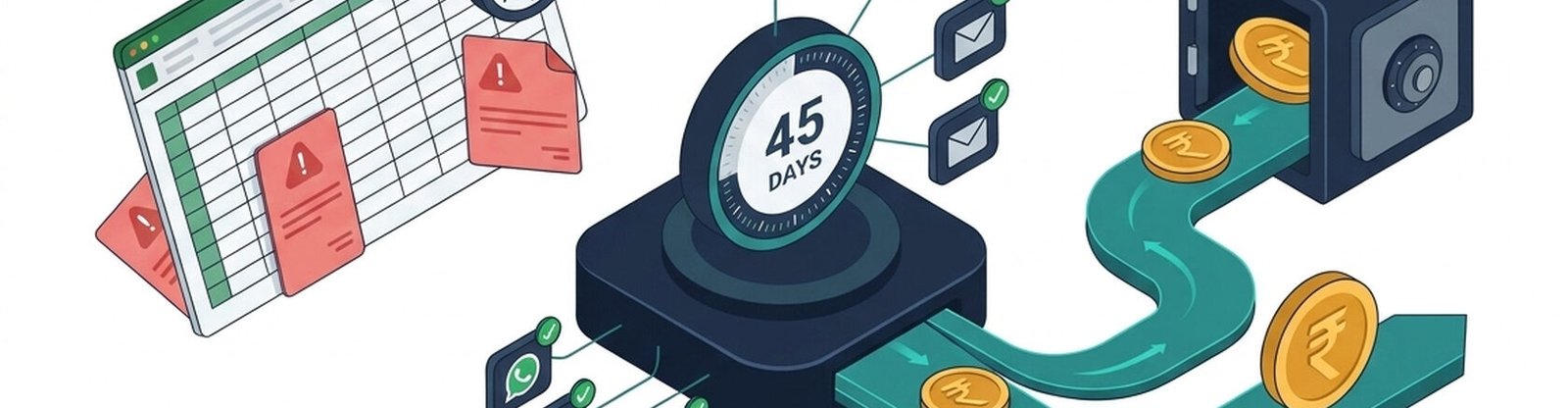
For a lot of Indian manufacturers, wholesalers, and SMEs selling on credit, the P&L looks great on paper—while the bank balance tells a completely different story. Trucks are leaving the gate every day, yet working capital stays trapped in the market because customer payments arrive weeks or months late.
When your accounts team is still relying on exported Excel aging sheets, manual phone calls, and reminders sent after a bill is already overdue, your Days Sales Outstanding (DSO) quietly creeps up and cash gets tight. With the MSMED 45-day payment rule and the new Income-tax Act, 2025 provisions kicking in for Tax Year 2026–27, messy receivables tracking isn’t just a cash-flow headache anymore—it carries real tax and compliance risk.
Here is how custom Accounts Receivable automation from Dave Creation helps Indian B2B businesses bring down DSO, enforce credit limits, and keep cash moving.
Key Takeaways
- Excel follow-ups lock up your cash: Waiting to make manual phone calls after an invoice turns overdue pushes your DSO up even when sales are booming.
- Missing the 45-day window now hurts at tax time: Under the MSMED Act, 2006 and Section 37(2)(g) of the Income-tax Act, 2025 (effective Tax Year 2026–27), buyers who pay registered Micro or Small suppliers late lose expense deductions and owe compound interest.
- Early ERP nudges get bills paid faster: Automated WhatsApp and email reminders with payment links at Day 15, Day 30, and Day 40 prompt buyers before an invoice ever goes past due.
- Dispatch holds stop bad debt early: Automatic MSME Udyam tagging and credit-limit holds pause risky orders before more stock leaves your warehouse.
The MSME 45-Day Rule and What Changes in 2026–27
Whether you are supplying on credit or buying from smaller vendors, the legal clock on B2B payments is strict:
- The 15-to-45-Day Window: Under Section 15 of the MSMED Act, 2006, payments to registered Micro and Small Enterprises must be cleared within your agreed credit period—capped at 45 days from acceptance of goods or services, or 15 days if there is no written agreement.
- Compound Interest & Tax Disallowance: Under Section 16, late payments attract compound interest at three times the RBI bank rate, and that interest isn’t tax-deductible. Starting Tax Year 2026–27, Section 37(2)(g) of the Income-tax Act, 2025 (which replaces the older Section 43B(h)) disallows the buyer’s expense deduction for that financial year if payment to a Micro or Small supplier crosses the statutory deadline.
- MSME Samadhaan Recourse: If a buyer still doesn’t pay on time, registered suppliers can file a formal delayed-payment claim on the MSME Samadhaan portal.
For MSME suppliers, that gives you serious leverage—as long as your invoices, Udyam records, and reminder logs are clean. For buyers, missing one due date buried in a spreadsheet can mean an unpleasant tax bill at year-end.
Measuring the Leak: Your DSO Number
Before automating collections, look at how many days it actually takes to turn credit sales into cash in the bank:
DSO = (Accounts Receivable ÷ Total Credit Sales) × Number of Days
If your DSO is sitting at 65 or 75 days while you have to pay your own suppliers in 30 or 45 days, you are basically acting as an interest-free bank for your customers.
How ERP Automation Cuts DSO Without Awkward Phone Calls
Moving collections out of spreadsheets and into your ERP turns follow-ups into a steady, predictable routine:
- Automated Pre-Due Nudges (Day 15, 30, and 40): Instead of waiting until a bill is 60 days old, your ERP sends polite WhatsApp and email reminders—complete with the PDF invoice and a one-click payment link—at Day 15, Day 30, and Day 40 from the invoice date. Because these nudges arrive before the due date, they remind buyers of their own tax-deduction deadline without putting your sales team in an awkward spot.
- Udyam Tagging & 45-Day Countdown Alerts: A custom ERP tags every buyer and supplier with their MSME Udyam status and runs a live 45-day countdown on open bills. Your finance team can spot right away which invoices carry Section 37(2)(g) urgency.
- Credit Limits & Automatic Dispatch Holds: If a dealer’s overdue balance crosses their approved credit limit or aging cutoff, the ERP automatically puts new sales orders and dispatches on hold until payment clears or management signs off on an exception.
At Dave Creation, we build custom ERP and Accounts Receivable workflows tailored for Indian B2B operations—tying invoicing, WhatsApp and email reminders, credit holds, and MSME compliance tracking into one system. You can find more practical operations and engineering guides on the Dave Creation Blog (add your blog URL).
Let Your System Handle the Follow-Ups
Healthy cash flow doesn’t come from your accounts team spending every afternoon chasing overdue bills on the phone. It comes from having a system that enforces credit rules automatically. Combine MSME 45-day tracking with scheduled reminders and dispatch holds, and your working capital stays where it belongs—in your business.
Looking to build an automated Accounts Receivable and MSME-compliant ERP setup? Reach out via the Dave Creation Contact Page to talk through what your workflow needs.
Frequently Asked Questions (FAQs)
1. Does the MSME 45-day payment rule apply to all businesses and traders?
No. Under the MSMED Act, 2006, the mandatory 15-to-45-day payment protection and Section 37(2)(g) tax disallowance apply specifically to registered Micro and Small Enterprises (manufacturers and service providers)—not to medium enterprises or pure wholesale/retail traders.
2. Do automated WhatsApp reminders from an ERP count as valid follow-up records?
Yes. Automated WhatsApp and email reminders carrying the invoice number, due date, and delivery timestamps give you a clear, time-stamped log of payment follow-ups alongside your ERP ledger and GST invoices.
3. What can a supplier do if a buyer still doesn’t pay within 45 days?
If an invoice stays unpaid past the 45-day (or 15-day) limit, a registered Micro or Small supplier can file a recovery application with the Micro and Small Enterprises Facilitation Council (MSEFC) through the MSME Samadhaan portal to claim both the principal and statutory compound interest.
Leave a Comment